
The Hidden Cost of In-House Dev in the 2026 Resource Crisis
Modsen
Summary
A practical perspective for C-level leaders on why in-house development has become harder to manage financially in 2026. It explains how rising hardware prices, AI-driven infrastructure overhead, and fixed internal teams are affecting margins. The author reframes green engineering as a cost-control discipline and outlines why outsourcing models are increasingly used to reduce risk and improve predictability.

Eugene Kalugin
CTO at Modsen
2026 has exposed a problem many companies didn’t know they had.
Development costs are rising faster than revenue, even in businesses with stable products and experienced teams. The reason? The hardware market has changed. Memory and storage are no longer cheap or easy to scale. Prices are rising, supply is tight, and infrastructure decisions now show up directly in financial reports. What used to be a background concern has become a line item the business cannot ignore.
This shift has caught many companies off guard. Models built around full in-house ownership – teams, servers, long-term capacity – were designed for a different reality. In 2026, they are starting to work against the very margins they were meant to protect.
In this piece, I’ll explain why internal development has become harder to control financially, how hardware and AI costs quietly eat into budgets, and why moving toward a lighter delivery model is becoming a practical business decision – not a technical preference.
Why internal teams are losing financial predictability in 2026
For a long time, in-house development felt like the safest option. You hired people, built a team, bought infrastructure – and expected stability in return. That logic worked when hardware was cheap and easy to scale. Today, it doesn’t.
In 2026, internal teams are no longer just a delivery function. They have become a fixed cost structure in a market where costs are anything but fixed. Salaries, infrastructure, and long-term capacity commitments stay in place – even when demand, prices, and priorities change.
This is where predictability breaks.
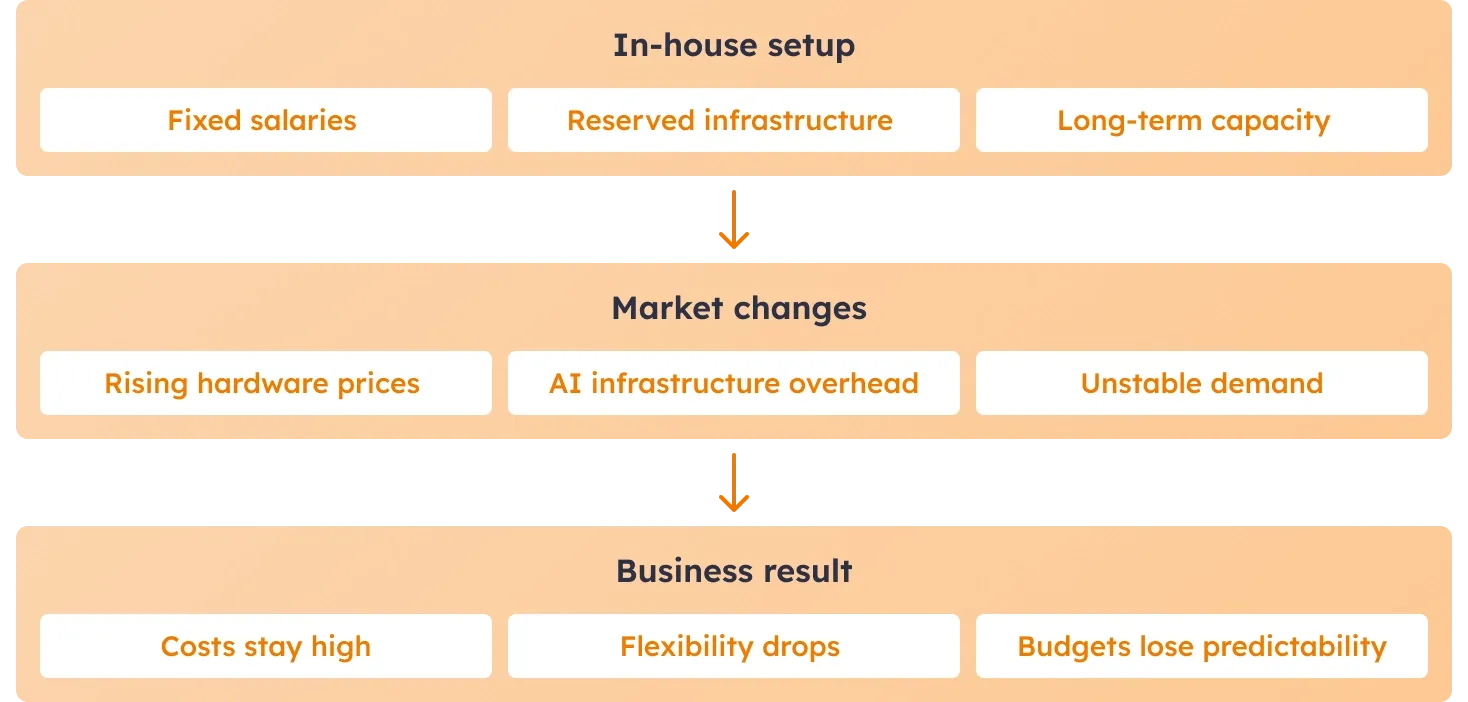
When costs are fixed but the market isn’t, predictability disappears
The budget blind spot
Most companies plan development budgets in annual cycles. Hardware markets don’t follow that rhythm. Memory prices go up when supply tightens. Cloud bills rise when usage grows – even slightly.
Internal teams, however, are built around buffers: extra capacity “just in case,” servers sized for future growth, resources reserved long before they are actually needed. What used to feel like caution now behaves like locked money.
You keep paying for capacity whether you use it or not. And as prices rise, those unused resources quietly eat into ROI.
The AI cost you didn’t plan for
AI didn’t just change products. It changed infrastructure. Modern systems now reserve memory and storage for AI-related processes by default – even before your application starts doing real work. This means a growing part of your infrastructure budget is consumed automatically.
From a business perspective, the effect is simple: you are paying more to run the same system. If your internal team builds features without strict limits on resource use, every update adds cost – not once, but every month. You’re no longer paying only for new functionality. You’re paying for the extra load that comes with it.
The talent mismatch
Many in-house teams were hired for speed. Their job was to ship features fast. In 2026, the priority has shifted. Efficiency now matters as much as velocity.
At the same time, companies face rising salary pressure, return-to-office debates, and a shrinking pool of engineers who know how to build systems that stay lean under load. The result is uncomfortable: teams become expensive to maintain and harder to adapt. You still have control – but over a cost structure that no longer fits the market reality.
“Green engineering” as a profit issue
Green development was treated as a secondary topic for a pretty long time – something good to have but rarely tied to financial decisions. That separation no longer exists. What used to be discussed as sustainability has become a cost issue.
The evolution of green engineering
Feature | Then: Sustainability initiative | Now: Cost discipline |
|---|---|---|
Market status | Optional | Mandatory |
Primary driver | Ethics-driven | Budget-driven |
Financial role | "Nice-to-have" | Direct impact on margins |
Measurement | Hard to measure | Predictable ownership and operating costs |
What used to be a values discussion has become a financial one
Our partners know this about how we work at Modsen: resource efficiency has never been optional for us. From the start, we have built systems to use only what they actually need. Not as a statement, but as a rule. Lean software is easier to scale, cheaper to run, and more predictable for the business.
What has changed is the context. What used to be a conscious choice is now a necessity. A few years ago, inefficient code could be offset with more RAM. Today, hardware is costly and limited. In this reality, resource-aware engineering is one of the most practical ways to keep costs under control and protect margins.
And at this point we move from the concept to the practical side of the issue.
How delivery models adapt to rising infrastructure costs
Resource-efficient engineering makes sense in theory. In practice, it’s hard to implement inside a fully in-house team.
Most internal setups were built when hardware was cheap and scaling was predictable. They work well for product knowledge and long-term direction. But asking the same teams to suddenly operate under strict resource limits isn’t just a technical change – it’s a structural one.
For leadership, the key question now is no longer whether teams are capable. It’s who carries the risk. Internal teams are best focused on core business logic and strategy. They are not built to absorb sudden hardware price increases or the extra infrastructure load that comes with AI.


The strategy for 2026 is simple: keep the vision in-house, and outsource the footprint.
This isn’t about bringing in someone to fine-tune servers. It’s about a delivery model where an external partner takes responsibility for execution and efficiency. While your internal team focuses on what to build, a tech partner handles how it runs – from system architecture to the ongoing development of resource-heavy parts.
By moving to a lighter delivery model, you gain flexibility. You keep control over direction and priorities, while the work of scaling, optimizing, and managing infrastructure is handled by a team built for it.
In 2026, success is less about owning everything and more about limiting exposure. Shifting away from fixed ownership toward a resource-aware delivery model helps protect margins and makes growth easier to manage.
What to do next
The in-house model was built for a world that no longer exists – a world of cheap hardware and predictable scaling. In 2026, that reality has changed. Resources are limited, prices move fast, and fixed cost structures are harder to control.
My advice is straightforward: don’t pay for market inertia. If your infrastructure costs are growing faster than your revenue, the issue is rarely the product itself. More often, it’s the delivery model behind it.
Shifting toward a partner focused on resource-efficient engineering is not a technical upgrade for its own sake. It’s a practical way to reduce exposure, keep costs predictable, and protect margins as conditions continue to change.
So if the question is “What’s next,” my answer is simple: start with a conversation. These are not issues best answered alone. Let’s connect and talk through your specific situation – openly and without obligation. I’m always glad to help.

Get a weekly dose of first-hand tech insights delivered directly to your inbox